
Looking for a comprehensive smoke alarm maintenance checklist for caregivers? Ensuring your aging parents are safe at home starts with the basics. You walk into your parent’s house with a bag of groceries, and before you even reach the kitchen counter, you hear it. That high-pitched, rhythmic chirp echoing from the hallway ceiling.
For you, a low battery in a smoke alarm is a minor annoyance. You grab a step stool, pop in a new 9-volt battery, and get on with your day. But when you are helping an aging parent stay independent at home, safety checks look entirely different.
Your mom might not have been able to hear that chirp due to age-related hearing loss. Even if she did, climbing a ladder to fix it could lead to a devastating fall. Worse, she might have been tempted to simply knock the device off the ceiling with a broom handle just to make the noise stop, leaving her completely unprotected.
When you manage an older adult’s care, home safety routines easily become part of your weekly visits—right alongside setting up pill boxes and reviewing doctor appointments. One item that requires your absolute attention is the home’s fire safety system.
A smoke detector only protects your loved one if it is working properly, installed correctly, regularly tested, and replaced when needed. For family caregivers, having a simple, predictable maintenance routine provides the confidence that your parent’s home is truly prepared for an emergency.
Why Smoke Alarm Maintenance Matters for Seniors
When we evaluate a home for an older adult, we have to view standard safety devices through a different lens. A system designed for a thirty-something homeowner might not serve an eighty-five-year-old effectively. Older adults face a unique set of physical and cognitive changes that make proper smoke alarm maintenance absolutely vital.
Hearing Changes
Many older adults experience high-frequency hearing loss, known as presbycusis. Standard smoke alarms emit a piercing beep at a frequency of around 3100 Hertz. Unfortunately, this is exactly the pitch that many seniors lose the ability to hear first. An alarm could be blaring in the hallway, and a parent sleeping in the next room might not wake up. Proper maintenance includes verifying that the specific alarms installed are actually audible to your parent.
Mobility Challenges
In a fire, you typically have less than two minutes to safely escape. For a senior relying on a walker, a cane, or simply dealing with stiff joints, a fast evacuation is incredibly difficult. This means early detection is critical. A well-maintained system buys them the extra seconds they desperately need to reach the front door. Furthermore, mobility challenges prevent your parent from climbing up to test the alarms themselves, putting the responsibility squarely on the caregiver’s shoulders.
Memory Changes
Alzheimer’s disease and other forms of dementia change the way a person processes the world around them. A senior with cognitive decline might forget what a loud, sudden noise means. Instead of evacuating, the noise might frighten them into hiding under a bed or in a closet. They might also forget when batteries need changing or attempt to dismantle the alarm because the blinking light bothers them.
Living Alone
If your parent lives alone, you are not there every night to smell smoke or hear the alarm. The equipment has to function flawlessly on its own. It needs to alert your parent, and ideally, it needs to alert you or emergency services simultaneously. When a senior lives solo, preventative maintenance stops small safety issues from becoming tragedies.
Caregiver Smoke Alarm Maintenance Checklist For Caregivers
Managing a parent’s home maintenance can feel overwhelming, especially when you are balancing your own household, a job, and kids. Breaking smoke alarm maintenance into a recurring schedule makes it manageable.
Smoke Alarm Maintenance
A Senior Safety Checklist for Dedicated Caregivers
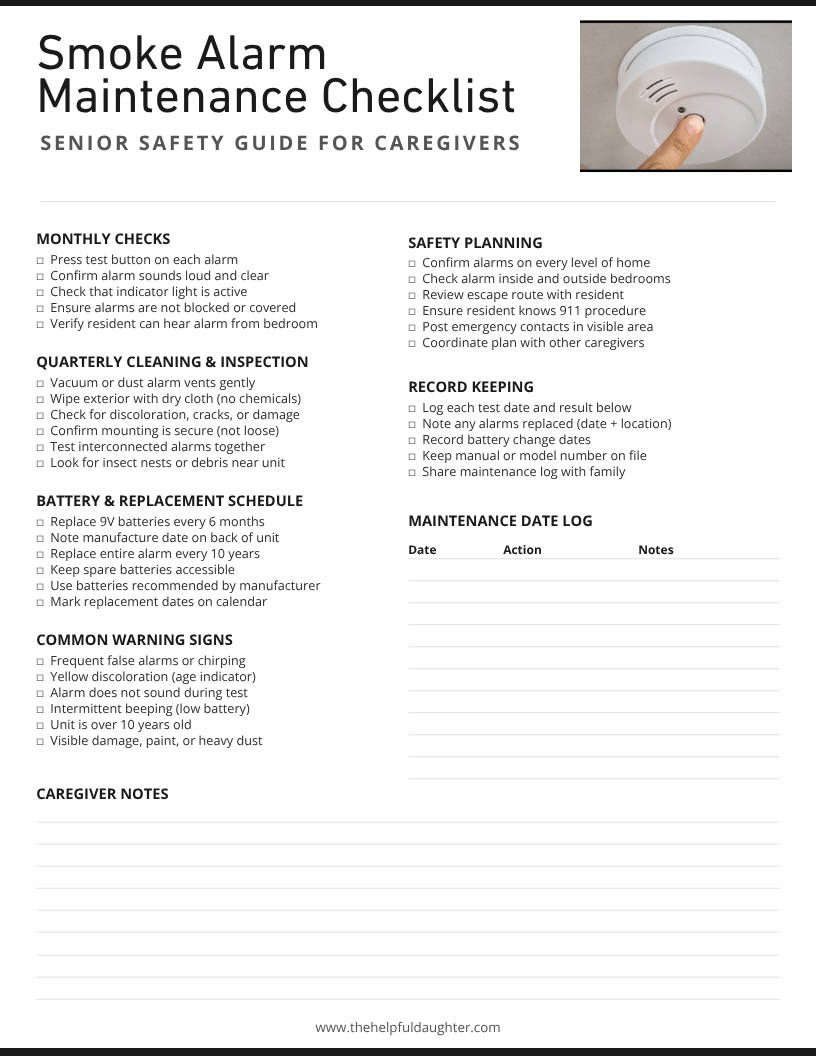
Free Smoke Alarm Maintenance Checklist
Keep your aging parents safe without the guesswork. Track monthly tests, battery replacements, and critical replacement dates in one simple printout.
Instant PDF download • No sign-up required
When Should Smoke Alarms Be Replaced?
A common misconception among homeowners is that a smoke alarm lasts forever as long as you change the battery. This is entirely false. The sensors inside these devices degrade over time.
The golden rule for smoke alarms is that they must be replaced every 10 years.
To find the age of the alarm, twist it off its mounting bracket and look at the back. The manufacturer prints a “Date of Manufacture” on the label. If that date was more than 10 years ago, throw it away and buy a new one.
However, you should replace the alarm sooner if you notice any of these issues:
- ☐ The alarm is visibly damaged: Cracked casing, deep yellowing of the plastic, or broken battery doors.
- ☐ It frequently gives false alarms: If it goes off every time your parent boils water, the sensor is likely failing.
- ☐ It does not respond during testing: If you press the test button and nothing happens (and you know the battery is fresh), the unit is dead.
- ☐ It is outdated: If it requires rare batteries or replacement parts that are no longer sold.
3 Signs Your Smoke Alarm System Needs Updating
Sometimes maintaining the current system isn’t enough; the system itself needs an overhaul. As a caregiver, you should evaluate whether your parent’s home requires modernized protection.
1. The Home Uses Only One Smoke Alarm
Many older homes were built when building codes only required a single smoke alarm in the main hallway. This is incredibly dangerous by modern standards. If a fire starts in the basement or the kitchen, that single hallway alarm might not trigger until the house is filled with toxic smoke.
2. The Alarm Only Makes Noise
A traditional beeping alarm is great for a healthy adult. But consider upgrading your parent’s system if they have:
- Hearing loss: They require visual alerts (strobe lights) or tactile alerts (bed shakers).
- Dementia: A blaring siren induces panic. Voice-alert systems that clearly state, “Warning: Smoke in the Kitchen,” help ground a senior in reality and direct them on what to do.
- Mobility challenges: Interconnected Smoke Alarms for Seniors are essential here. If a fire starts in the basement, the alarm in their main-floor bedroom will sound immediately, giving them maximum time to slowly safely evacuate.
3. There Are No Caregiver Alerts
If your parent cannot call 911 themselves, an alarm that only makes noise in an empty house is a tragedy waiting to happen. Smart systems alert your smartphone the second smoke is detected, allowing you to dispatch emergency services immediately.
Smoke Alarm Maintenance Tips for Long-Distance Caregivers
Caring for an aging parent from another city or state introduces intense logistical challenges. You cannot pop over on a Saturday morning to check a chirping detector. However, you can still oversee their safety effectively.
Create a Safety Schedule
Do not rely on your parent to remember to check their alarms. Set a recurring calendar reminder on your own phone. When it goes off, coordinate the maintenance check with someone local.
- Call a sibling or family member who lives nearby.
- Ask a trusted neighbor if they would mind pressing the test button once a month.
- If your parent has paid home care workers, add “monthly smoke alarm test” to their official care plan duties.
Keep a Home Safety Record
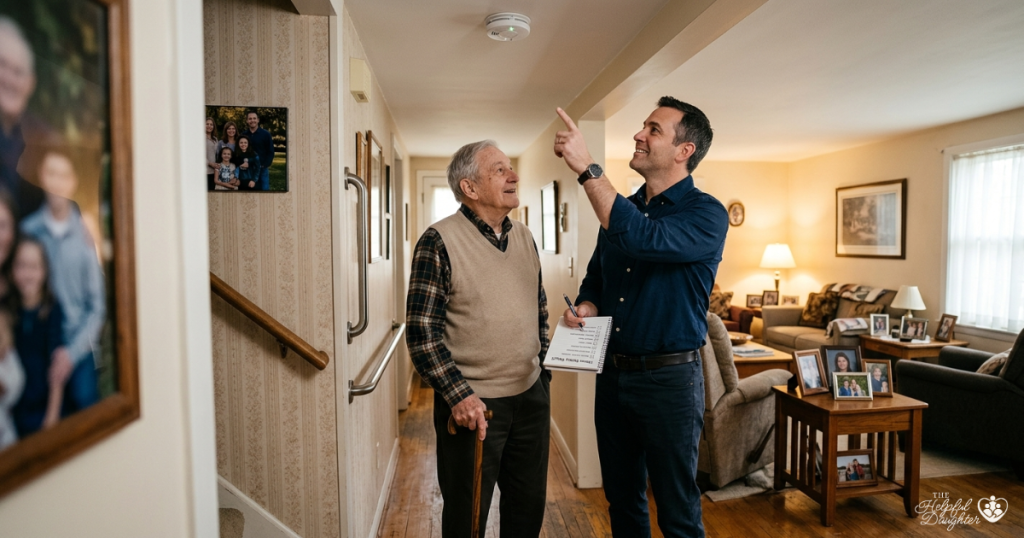
When you are managing care from a distance, details slip through the cracks. Keep a digital logbook (like a shared Google Doc or a note on your phone) with the following information:
- Date checked: (e.g., March 1st)
- Battery replaced: (e.g., Living room and hallway, Oct 2023)
- Alarm age: (e.g., Kitchen alarm expires 2028, Bedroom alarms expire 2031)
- Next inspection due: (e.g., April 1st)
Use Smart Home Technology
For long-distance caregivers, smart home technology is a profound stress reliever. Connected smoke alarms sync to the home’s Wi-Fi network. From your phone 500 miles away, you can see if the batteries are full, if the sensors are working, and most importantly, you will receive an instant push notification if the alarm triggers.
Common Smoke Alarm Mistakes Caregivers Make
Even well-intentioned caregivers can miss critical details when managing home safety. Here are the pitfalls you should actively avoid.
Mistake #1: Assuming the Alarm Works Just by Looking at It
A smoke alarm sitting quietly on the ceiling does not guarantee protection. Caregivers often walk through a parent’s house, see the plastic disc above them, and check it off their mental list. Unless you press the test button, you have no idea if the internal wiring is fried, if the battery is completely dead, or if a bug has nested in the sensor.
Mistake #2: Forgetting About Older Alarms
It is incredibly common for families to live with alarms that are 15 or 20 years old. Because the device still chirps when you press the test button, people assume it works. The test button only confirms the battery and the horn are working. It does not test the smoke sensor. After a decade, that sensor is no longer reliable.
Mistake #3: Installing Alarms but Not Practicing
Caregivers will often spend hundreds of dollars installing a premium, interconnected fire safety system, but fail to tell their parent how it works. A senior needs to know what to do when the alarm sounds. If they rely on a walker, what is their fastest route out? Do they know not to stop and gather their purse or medication? Practice the plan.
Mistake #4: Ignoring Hearing Challenges
A blaring 85-decibel alarm is completely useless if the person sleeping below it cannot hear that specific frequency. Caregivers frequently underestimate their parent’s hearing loss at night when hearing aids are removed. If your parent takes out their hearing aids to sleep, standard alarms are a massive safety gap.
The Top 3 Best Smoke Alarm Styles
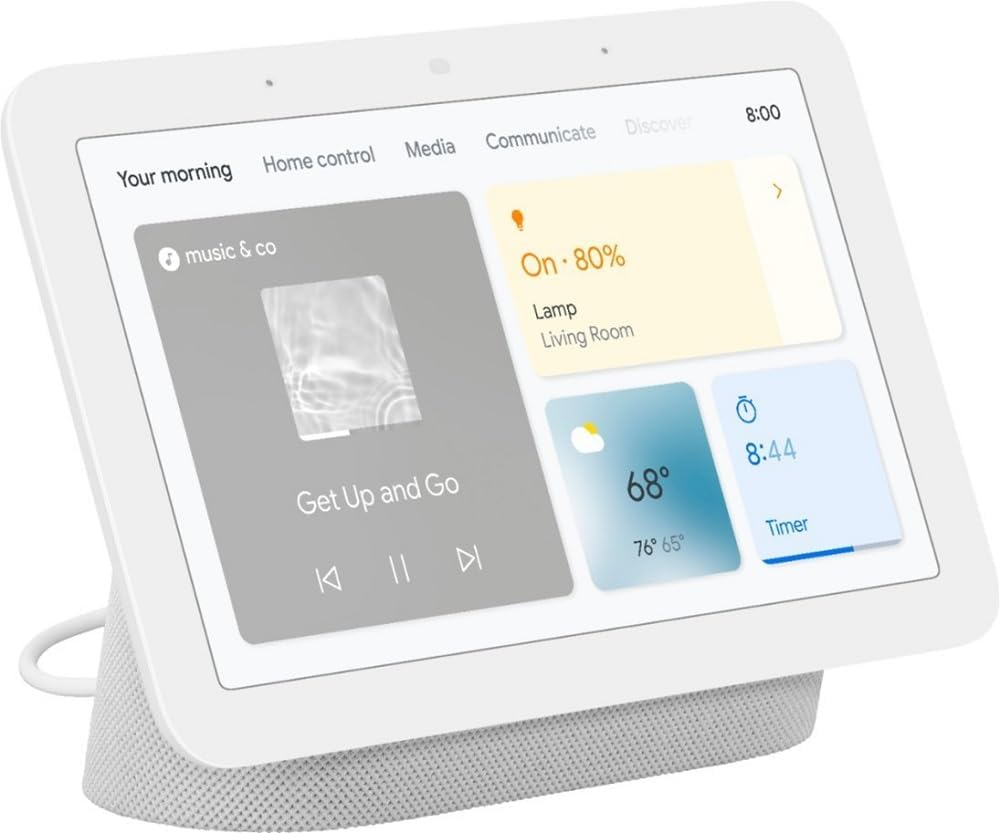
Google Nest Protect
Best For: Long-distance caregivers & seniors with mild dementia
An advanced smoke and carbon monoxide detector that connects seamlessly to your phone. It tests itself automatically, detects both fast-burning and slow, smoldering fires, and speaks in a friendly, calm voice to alert you to danger before sounding a harsh alarm.
Key Features
- Split-Spectrum Sensor: Uses two wavelengths of light to identify multiple fire stages quickly.
- Voice & Light Alerts: Communicates danger in a calm voice detailing the exact room and hazard type.
- Smartphone Interconnectivity: Receives real-time status alerts and allows you to hush false alarms directly from your phone.
- Pathway Light: Features a motion-activated nightlight to illuminate dark hallways safely.
Pros
- Whisper-quiet monthly self-testing
- Tells you exactly where danger is
- In-app remote silencing feature
- Differentiates steam from smoke
Cons
- High initial price point
- Requires Wi-Fi for full smart feature set
- Must be replaced entirely after 10 years
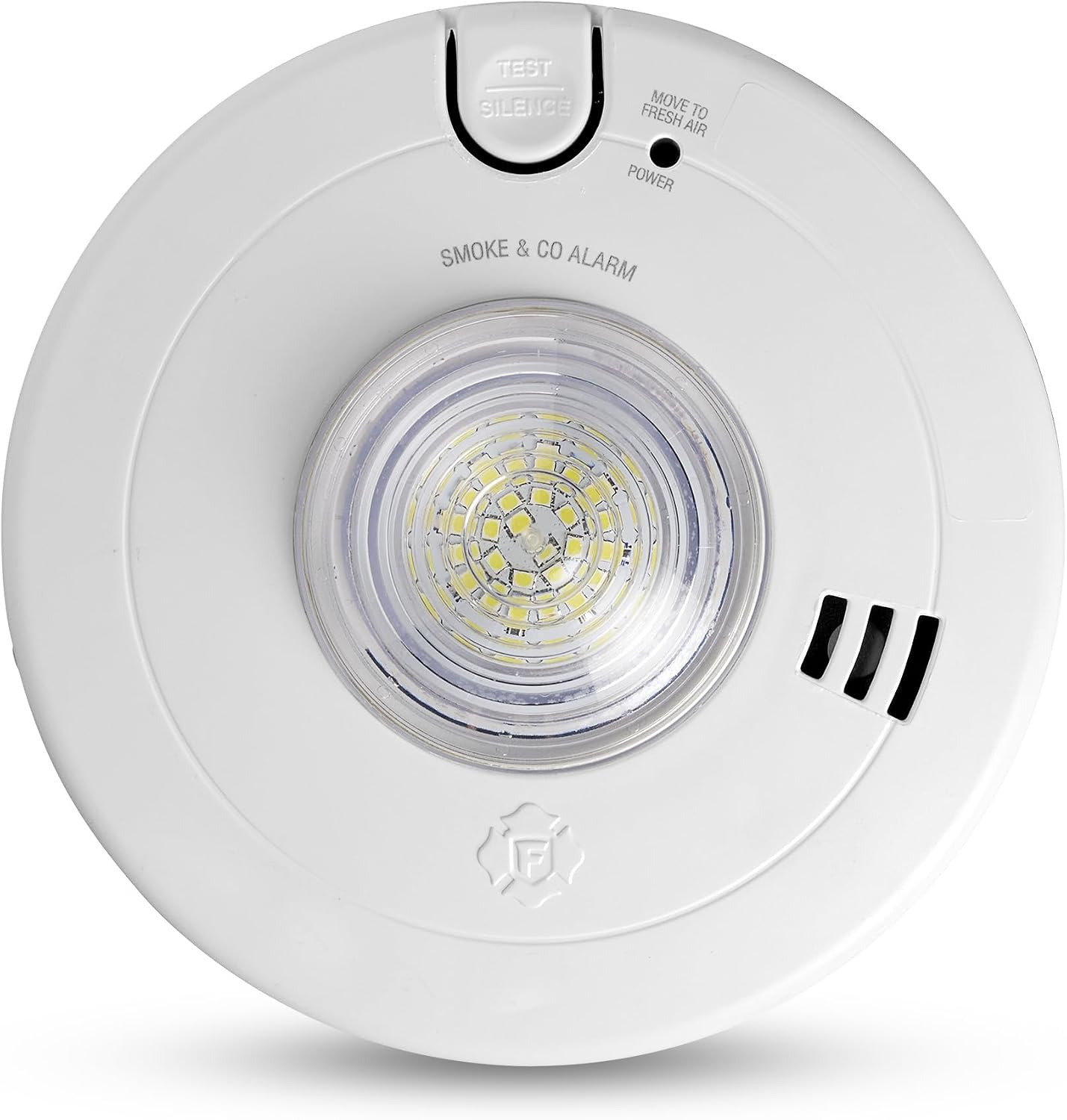
First Alert 10-Year Sealed Battery Alarms
Best For: Caregivers looking for low-maintenance, budget-friendly options
An incredibly reliable, set-it-and-forget-it safety option. Driven by an integrated lithium battery designed to last a full decade, it keeps your aging loved ones safe without the anxiety of middle-of-the-night battery chirps.
Key Features
- 10-Year Sealed Battery: Powered by a lithium battery that provides continuous power for a decade.
- Zero Battery Changes: Eliminates the need to ever climb ladders to replace fading 9-volt batteries.
- Tamperproof Design: Locked casing prevents seniors from removing or disabling batteries out of frustration.
- Slim Profile: Sleek and compact aesthetic that blends cleanly into any ceiling decor.
Pros
- No battery maintenance for 10 years
- Highly budget-friendly option
- Saves seniors from ladder-climbing risks
- Prevents tampering or accidental disablement
Cons
- No smartphone connectivity or smart alerts
- Requires manual monthly test pressing
- Cannot sync alerts to distant caregiver phones
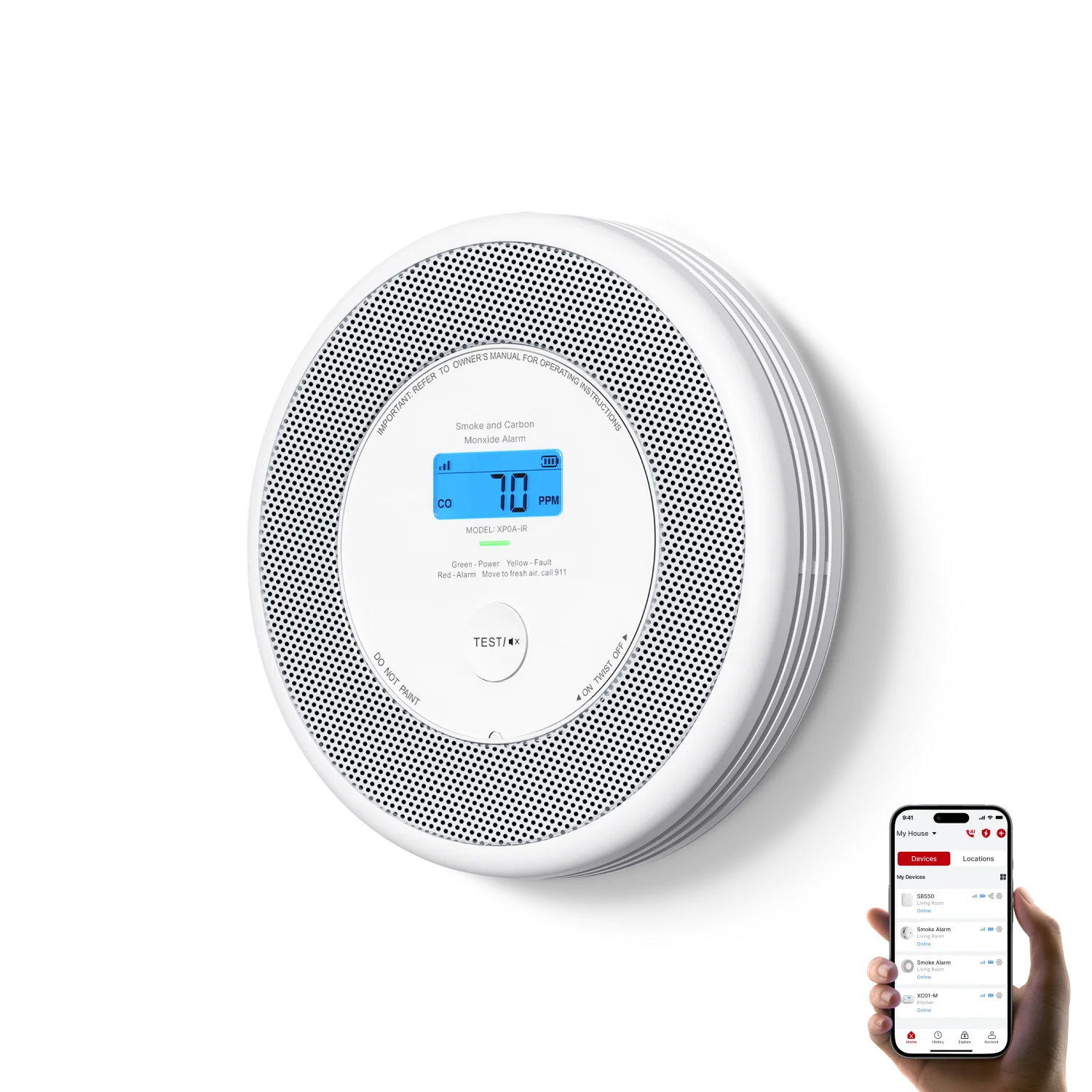
X-Sense Smart Smoke Alarms
Best For: Caregivers wanting smart home features on a tighter budget
A high-tech, budget-conscious security system that connects directly to your Wi-Fi. Featuring robust wireless interconnection and instant phone alerts, it provides modern safety peace of mind without the high cost of premium premium systems.
Key Features
- Wi-Fi Connected: Sends immediate warning notifications directly to your smartphone if an emergency occurs.
- Wireless Interconnection: If one alarm detects a hazard, all interconnected devices in the home sound off instantly.
- In-App Monitoring: Easily check battery life, check device connection status, and test the system from your phone.
- Photoelectric Sensor: Employs highly accurate optical technology to minimize cooking-related false alarms.
Pros
- Smart remote monitoring at an affordable price
- Saves critical evacuation time with interconnection
- Instant smartphone push notifications
- Easy wire-free mounting and setup
Cons
- Lacks voice-alert features
- Requires a stable home Wi-Fi connection
- Initial app configuration can take some time
Final Thoughts
Taking over home safety duties for an aging parent is a heavy responsibility, but maintaining their smoke alarms does not have to be complicated. By committing to a routine—testing monthly, cleaning quarterly, and replacing outdated devices—you create a reliable safety net for your loved one.
Assess your parent’s unique needs, especially regarding their hearing, mobility, and memory. Do not hesitate to upgrade their home to a smart, interconnected system if it will provide better protection and give you peace of mind. The small amount of effort it takes to manage these devices pays off exponentially by keeping your parent safe and independent in the home they love.
Frequently Asked Questions
How often should caregivers test smoke alarms?
Smoke alarms should generally be tested monthly to ensure they are working properly. Caregivers should press the test button on each unit until the alarm sounds loudly. If the alarms are interconnected, testing one should trigger all the others in the house. Consistent monthly testing confirms the battery, horn, and internal circuitry are all fully operational, giving you confidence that your parent is protected.
How often should smoke alarm batteries be replaced?
Battery replacement depends on the type of alarm and manufacturer recommendations, but caregivers should regularly check battery status. For traditional alarms using 9-volt or AA batteries, replace them at least once a year, or immediately if the unit starts chirping. If the alarm uses a sealed 10-year lithium battery, you never have to replace the battery; you simply replace the entire unit when it expires after a decade.
How often should smoke detectors be replaced?
Most smoke alarms should be replaced around every 10 years. The sensors inside the device degrade over time, losing their sensitivity to smoke particles. Check the back of the alarm for a printed manufacture date. If that date is more than a decade old, the unit is no longer reliable and must be completely replaced, regardless of whether the test button still makes a sound.
Should seniors have smart smoke alarms?
Smart smoke alarms can be helpful for seniors because they may provide caregiver notifications and easier monitoring. If a parent leaves a pan on the stove, the smart alarm will instantly send a push notification to the caregiver’s smartphone, no matter where they are. This allows the caregiver to immediately check in on their parent or call emergency services, making it an excellent tool for long-distance caregiving.
What is the best smoke alarm for a senior with hearing loss?
Standard alarms use high-frequency pitches that seniors often cannot hear, especially without hearing aids. The best alarms for hearing loss are those equipped with low-frequency sounds (around 520 Hz), high-intensity flashing strobe lights, and vibrating bed shakers. These tactile and visual alerts ensure that a sleeping senior will be woken up by physical vibration or bright light rather than relying on their ears.
How do I stop my elderly parent’s smoke alarm from chirping?
A chirping alarm usually indicates a low battery, but it can also mean the device has expired, is filled with dust, or has experienced a power surge. First, try replacing the battery. If the chirping continues, vacuum the vents to remove dust. If it still chirps, check the date on the back of the device; it likely has reached the end of its 10-year lifespan and requires full replacement.
Can a person with dementia understand a smoke alarm?
Seniors with moderate to severe dementia often lose the ability to recognize warning sounds. A loud siren might cause them to panic, freeze, or hide rather than evacuate. For these individuals, alarms with programmable voice alerts (which announce the danger calmly in a human voice) are highly recommended. Caregivers must also establish and repeatedly practice a simple physical escape routine so the response becomes muscle memory.
Where should smoke alarms be placed in a senior’s home?
Smoke alarms should be installed inside every bedroom, outside every sleeping area, and on every level of the home, including the basement. For seniors with mobility issues, early warning is critical, so having interconnected alarms in all these locations ensures they hear the warning from anywhere in the house. Keep alarms away from drafty windows, ceiling fans, and bathroom doors where steam can cause false alarms.
Who can help install smoke alarms for seniors?
If a caregiver is unable to safely climb a ladder to install alarms, do not risk a fall. Reach out to the local fire department; many run community outreach programs that offer free smoke alarm installation for older adults. Alternatively, hire a licensed local handyman, consult a certified aging-in-place specialist, or check with local senior centers for volunteer home-maintenance programs designed to assist the elderly.