
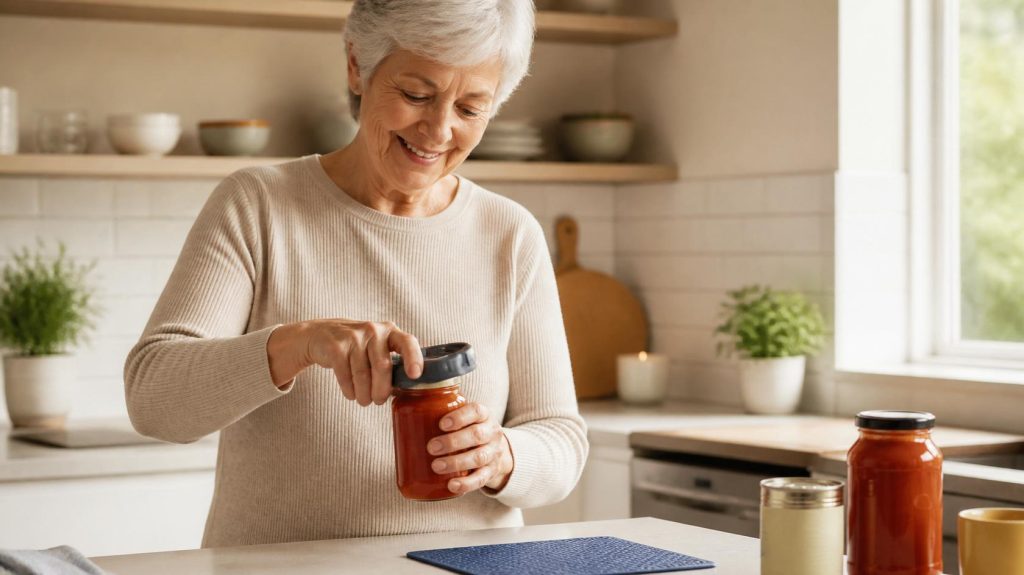
It usually starts with a jar of pasta sauce or a stubborn pickle lid. You hand it to your aging mom or dad, or maybe you find yourself struggling with it, tightening your grip, bracing the jar against your chest, and feeling a sharp, burning ache shoot right through your thumb joint. When you live with hand pain, rheumatoid arthritis, or osteoarthritis, the kitchen stops feeling like a warm, creative space and starts feeling like an obstacle course.
Everyday meal prep involves dozens of little twists, pulls, and punctures. Opening jars and cans with arthritis shouldn’t require brute force or leave your hands throbbing for the next hour. Losing that everyday independence can feel deeply discouraging, but you do not have to resign yourself to asking for help every time you want a snack.
In this guide, we are going to walk through practical, field-tested ways to make opening jars and cans with arthritis safe, painless, and entirely manageable. You will learn how leverage works to do the heavy lifting for you, which tools are actually worth your money, and how to set up an arthritis-friendly kitchen layout that protects your joints.
The Ergonomic Kitchen Approach: Let Physics Do the Work
When your joints are stiff or inflamed, using pure muscle power is a losing battle. The secret to an accessible kitchen isn’t buying expensive gadgets; it is understanding how to change your mechanics.
Leveraging Mechanical Advantage
In physics, a lever allows you to move a heavy load with a fraction of the force. In an arthritis-friendly kitchen, we apply this exact principle. Instead of gripping a lid with your bare fingers and trying to twist it using the small muscles of your wrist, ergonomic tools expand your radius or provide a long handle. This increases your leverage, meaning your hands apply minimal torque while the tool multiplies the force.
💡 Caregiver Quick Tip: Watch the Pinch Points
When shopping for kitchen tools, avoid items that require a tight, narrow pin-pinch grip. Look for wide, soft-touch handles that let you use your entire palm or forearm rather than your delicate finger joints.
Protecting Your Joints Over Time
Every time you force a stubborn lid, you put stress on the carpometacarpal (CMC) joint at the base of your thumb—the exact spot where hand arthritis hits the hardest. Protecting this joint prevents long-term joint deformation and keeps you cooking independently for years to come. By shifting tasks to tools designed for leverage, you preserve your daily energy for cooking meals you love rather than fighting packaging.
Best Practices and Tools for Opening Jars
Jars are notorious for creating a vacuum seal that locks the lid tight. Breaking that seal requires a mix of friction and leverage. Let us look at the best ways to handle jars without hurting your hands.
1. Rubber Grips and Jar Pads
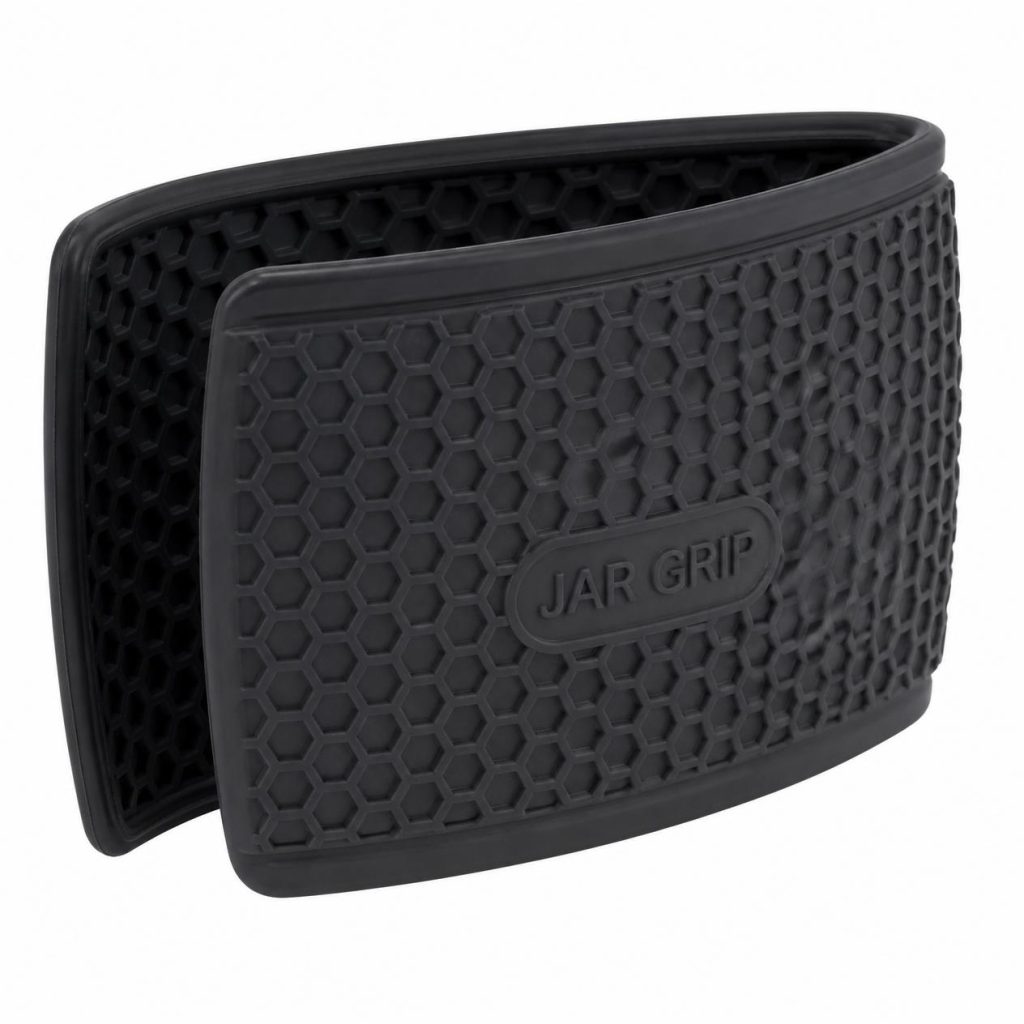
If your grip strength fluctuates day-to-day, a simple rubber textured pad is your first line of defense.
- How they work: They increase the friction between your palm and the lid, preventing your hand from slipping.
- Pros: Inexpensive, lightweight, easy to store in a drawer, and requires zero installation.
- Cons: They still require you to supply the twisting force, so they may not be enough on days when your joints are severely flared.
2. Under-Cabinet Jar Openers
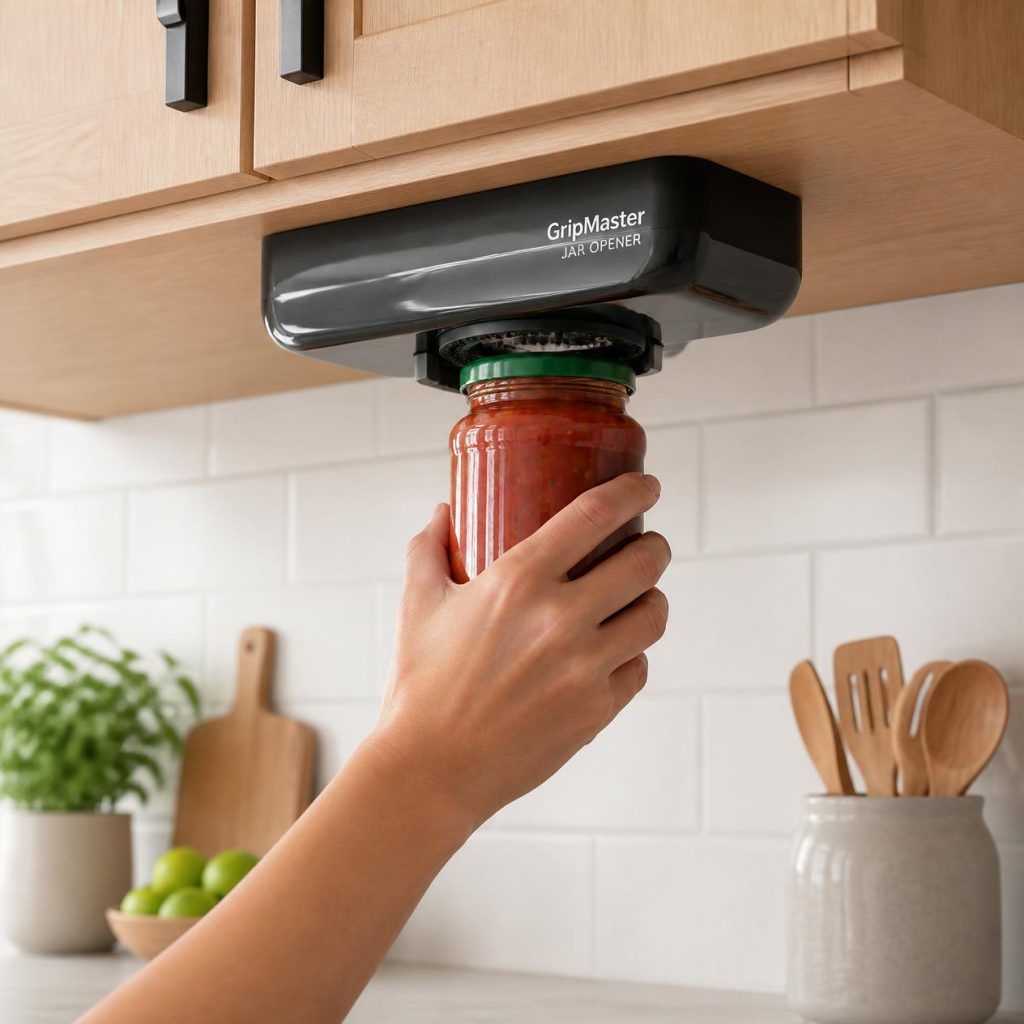
For a permanent, highly effective solution, consider mounting a V-shaped metal or rubber wedge underneath a kitchen cabinet or upper shelf.
- How they work: You slide the jar lid into the V-shaped teeth until it wedges tight, then simply rotate the jar body. The wedge holds the lid stationary while your stronger arm and shoulder muscles do the turning.
- Pros: Always in place, frees up drawer space, and takes almost all the strain off your fingers.
- Cons: Requires installation (usually adhesive or screws) and takes up a small amount of under-cabinet clearance.
3. Adjustable Leverage Wrenches
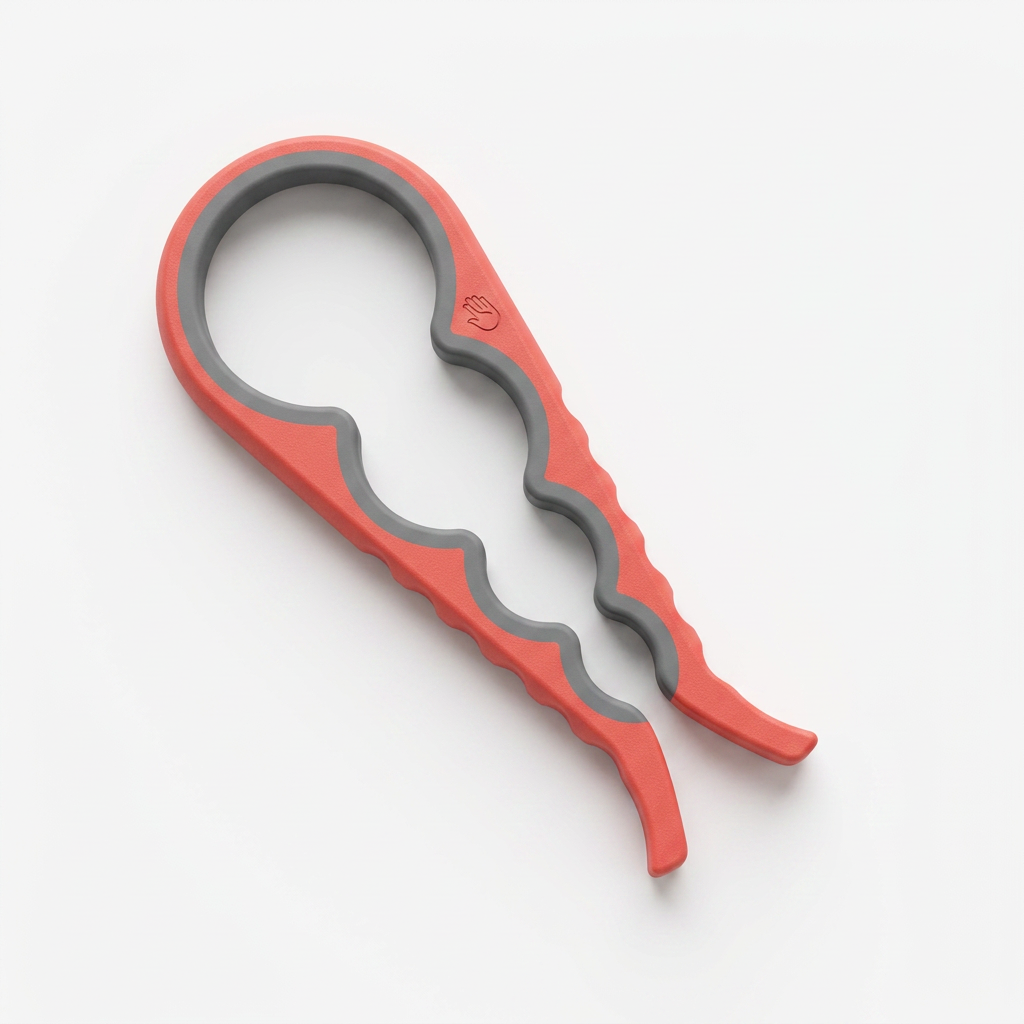
If you have jars of all shapes and sizes—from tiny spice jars to massive mayonnaise containers—an adjustable strap wrench or multi-size rubber grip tool offers maximum versatility.
Best Practices and Tools for Opening Cans
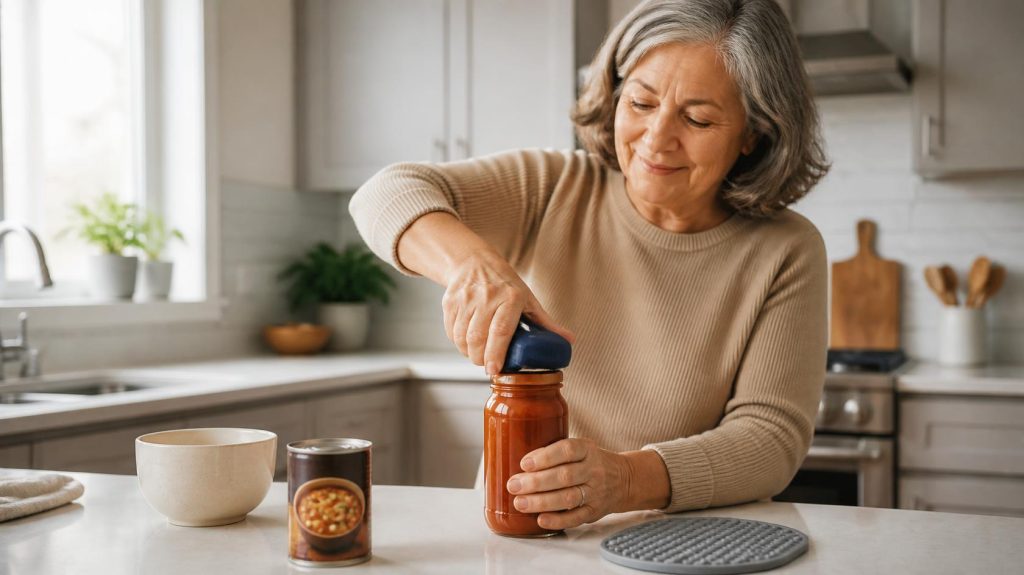
Traditional manual can openers require two simultaneous actions: squeezing hard with one hand to pierce the metal, and cranking a stiff rotary knob with the other. For someone with hand arthritis, this combination can feel nearly impossible.
The Dangers of Traditional Twisting Mechanisms
Standard butterfly can openers put intense, direct pressure on your thumb joints. Furthermore, they often leave sharp, jagged edges along the rim of the can and the lid, creating a secondary safety hazard for skin that may already be thin or sensitive.
Hands-Free Electric and Automatic Options
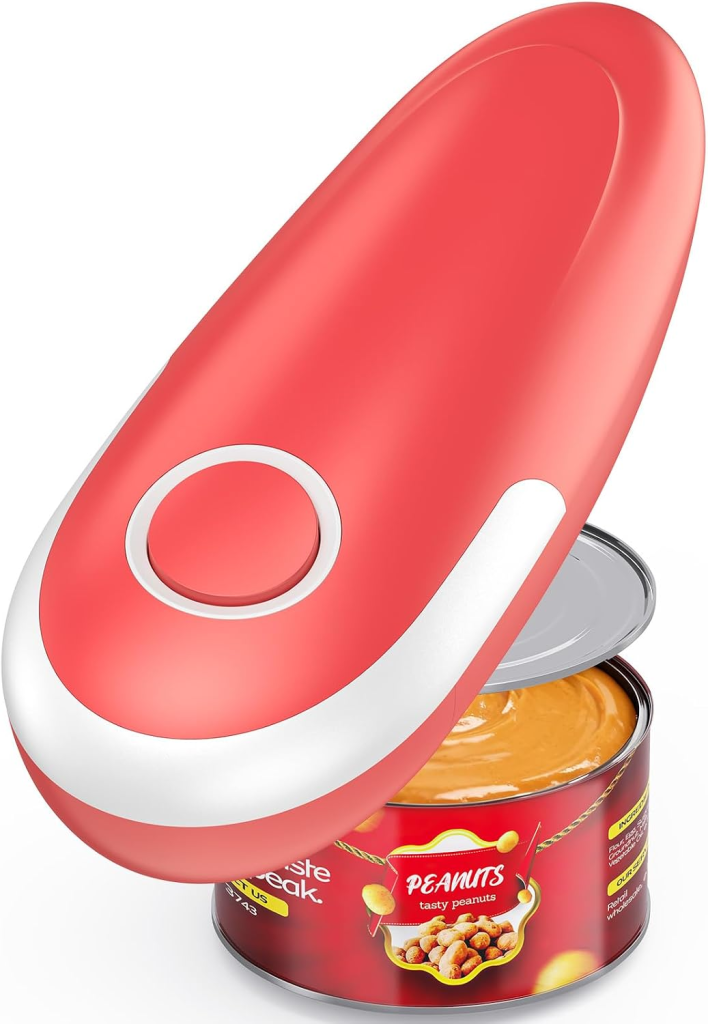
Switching to an automatic, one-touch can opener changes the entire cooking experience. You simply place the device on top of the can, press a single button, and let the motor walk around the rim autonomously.
- Side-cut technology: Many modern automatic openers cut along the side of the lid rather than the top. This leaves zero sharp edges on the rim or the lid, completely eliminating accidental cuts.
- Magnetic lid lifters: A built-in magnet catches the lid so it doesn’t drop into your soup or beans.
Step-by-Step Guide: How to Safely Open a Stubborn Jar Without Injury
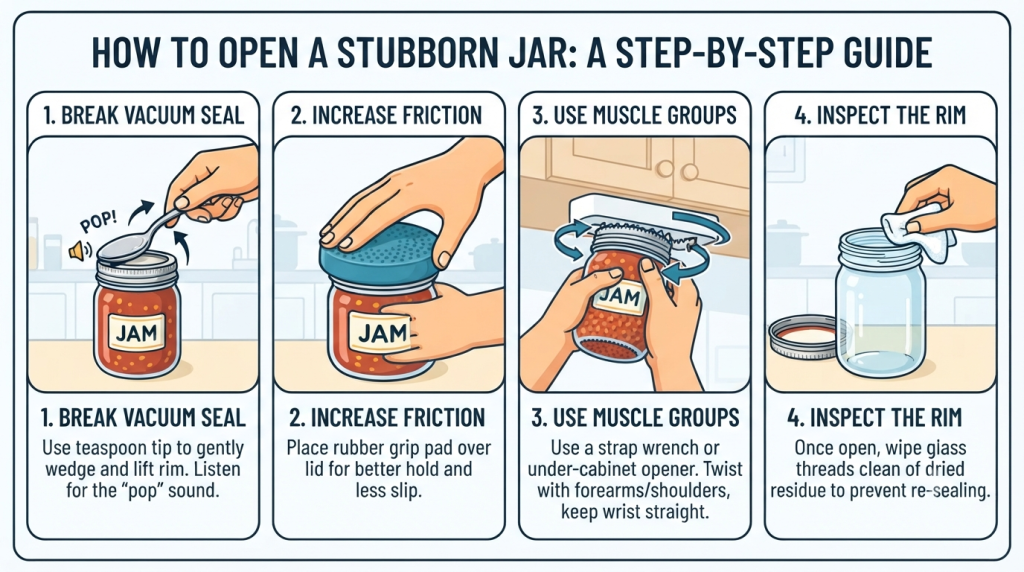
When you encounter a jar that refuses to budge, resist the urge to bang it against the counter or squeeze it with all your might. Instead, follow this step-by-step routine designed to protect your joints.
- Break the vacuum seal first: Take the edge of a teaspoon and gently wedge it under the rim of the lid, lifting outward just enough to hear a faint “pop.” This releases the air pressure holding the lid down.
- Increase friction: Place a rubber grip pad over the lid to ensure your hand or tool won’t slip during the next step.
- Engage your larger muscle groups: Position an adjustable strap wrench or place the jar into an under-cabinet opener. Instead of twisting with your wrists, keep your wrists straight and rotate using your forearm and shoulder movement.
- Inspect the rim: Once open, wipe away any dried sugar or sauce residue from the glass threads so it doesn’t seal shut again for next time.
Final Thoughts
Living with arthritis doesn’t mean giving up your independence in the kitchen. By swapping out brute force for clever engineering, utilizing rubber grips, installing under-cabinet wedges, and upgrading to hands-free electric can openers, you can protect your joints and take the pain out of daily meal preparation.
Small changes make a remarkable difference, giving you back the comfort, confidence, and joy of cooking on your own terms.
Common Caregiver Questions (FAQs)
Why do my hands hurt worse in the morning when trying to open kitchen packaging?
Joint stiffness is typically worse in the morning due to overnight fluid accumulation and joint inactivity, a phenomenon known as morning stiffness. It is best to avoid heavy food prep tasks right after waking up. Give your hands 30 minutes of gentle movement, warm water rinsing, and light stretching before tackling stubborn kitchen containers.
Are electric can openers safe for seniors with tremors?
Yes, most modern automatic electric can openers are exceptionally safe for individuals with mild tremors because they require only a single initial push of a button to start, and the machine stays balanced on top of the can on its own. You do not need to hold or steady the can while it cuts.
What is the best way to open a vacuum-sealed jar without any special tools?
If you are caught without tools, you can run the lid under hot tap water for 30 to 45 seconds. The heat causes the metal lid to expand slightly faster than the glass jar, breaking the tight vacuum seal. Always dry the lid thoroughly with a kitchen towel afterward so your hands do not slip.
Can hand exercises improve my ability to open jars?
Gentle range-of-motion exercises and strengthening routines recommended by occupational therapists can help maintain hand function. However, exercises are meant to preserve flexibility, not replace ergonomic tools. Always prioritize using mechanical leverage to protect your cartilage from excessive wear.
Is it safe to use a knife to pop open jar lids?
Using a knife blade to pry open jar lids is strongly discouraged. Knife blades can easily slip on slick glass, leading to severe cuts on your fingers and palms. Always use a dull spoon edge or a dedicated rubber-padded bottle opener instead.
How do I choose between a battery-operated can opener and a countertop model?
Battery-operated handheld models are compact, fit neatly in a drawer, and are great for travel or minimal counter space. Countertop electric models are heavier, plug into the wall, and offer greater stability for people who find even lifting a small battery-operated gadget tiring.
What should I look for when buying kitchen gadgets for someone with arthritis?
Look for products bearing the Ease-of-Use commendation or certification, wide non-slip handles, lightweight construction, and operation that requires minimal finger pinch strength. Ergonomic design should always favor palm pressure over finger pressure.
How can I reorganize my kitchen to make opening items easier?
Store your most frequently used items—like coffee, favorite spices, and cooking oils—in lightweight plastic containers with flip-top lids rather than heavy glass jars with screw-on tops. Keep heavy appliances and tools at waist height to minimize reaching and bending.