

When my dad first brought home his rollator walker, we thought getting it out of the box was the hardest part. It was shiny, lightweight, and promised a return to easy strolls around the neighborhood. But within five minutes, we realized that owning a mobility aid and knowing how to use a rollator safely are two entirely different things. He pushed it too far ahead, hunched his shoulders, and almost took a tumble when he tried to sit down without locking the brakes.
If you or an aging parent have recently transitioned to a four-wheeled rollator, you might notice that it feels a bit livelier—and less predictable—than a traditional, non-wheeled walker. Because rollators glide smoothly on wheels and feature hand brakes, they offer wonderful freedom, but they also require a bit of practice to master.
This guide walks you through everything you need to know about how to use a rollator correctly across different environments, protect your balance, and avoid the hidden safety traps that trip up many families.
1. Getting the Basics Right: Posture and Handle Height
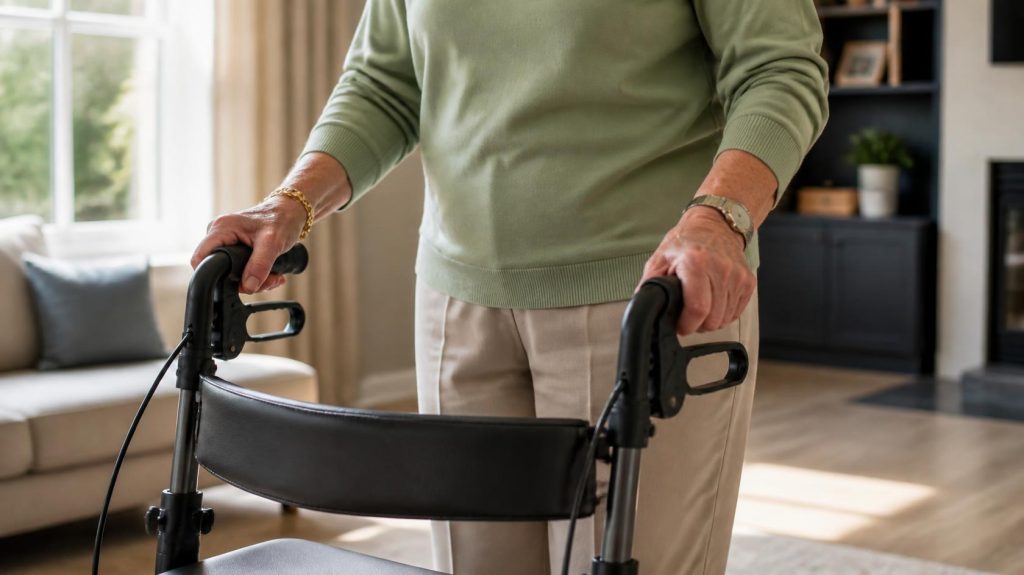
Before taking a single step, the rollator must be adjusted to fit the user’s specific body dimensions. When handles are set incorrectly, they force the spine into awkward positions, leading to lower back pain, shoulder strain, and a higher risk of losing balance.
How to Check Your Handle Height
- Put on supportive shoes: Wear the footwear you normally wear around the house or outside.
- Stand tall: Stand upright inside the rollator frame with your shoulders relaxed and your arms hanging naturally at your sides.
- Check the crease: The top of the rollator hand grips should line up precisely with the crease on the inside of your wrist.
- Inspect your elbows: When you place your hands on the grips, your elbows should have a comfortable, slight bend of about 15 to 20 degrees.
Caregiver Tip: Avoid the temptation to set the handles higher “just to have more room to lean.” A rollator is designed to support your balance, not to bear your full body weight. If the handles are too high, you will shrug your shoulders and fatigue quickly. If they are too low, you will hunch forward.
2. Walking Inside the Frame, Not Behind It
One of the most common habits we see with new rollator users is pushing the device too far ahead, as if it were a shopping cart. When the rollator drifts away from your body, your center of balance shifts forward. This forces you to chase after it, drastically increasing the chance of a forward fall.
- Stay close: Keep your hips aligned roughly with the rear wheels of the rollator.
- Walk inside the unit: Your feet should remain inside the boundary of the frame, not trailing far behind.
- Look forward: Keep your gaze up and ahead of you, scanning the path for obstacles, rather than staring down at your feet. Looking down rounds your upper back and shifts your weight dangerously forward.
3. Mastering the Brakes
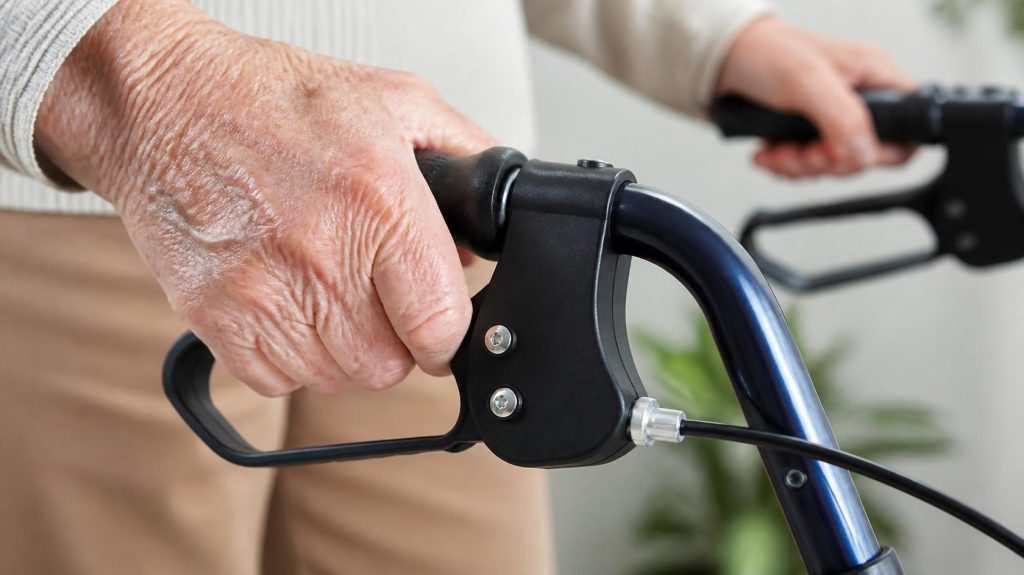
Unlike basic walkers that rely on rubber tips to create friction, rollators roll freely unless you actively control them. Understanding how the hand brakes work is the single most important skill for preventing accidents.
Brake Function Reference Table
| Action Needed | How to Execute | What It Does |
| Slowing Pace | Gently squeeze both brake levers upward toward the handles. | Creates steady, even friction to control speed on gentle slopes or descents. |
| Parking / Locking | Push both brake levers downward until they click firmly into place. | Locks the rear wheels completely so the rollator cannot move. |
| Resuming Movement | Pull or lift the brake levers back up to the neutral position. | Releases the wheel lock so you can walk forward smoothly. |
Safety Note: Always test your brakes periodically. Over time, brake cables can stretch slightly. If you notice the wheels can still turn while the parking brakes are engaged, use the small barrel adjuster nut near the brake cable to tighten the tension until the wheels lock securely.
4. How to Sit Down and Stand Up Safely Using the Seat

The built-in seat is one of the best features of a four-wheeled rollator, giving seniors the freedom to rest whenever fatigue sets in. However, this is also the exact moment when many preventable falls happen.
Step-by-Step Guide to Sitting Down
- Find flat ground: Never attempt to sit on a rollator when parked on an incline, a ramp, or uneven grass.
- Lock the brakes: Push both brake levers down into the locked position. Check this twice. If the wheels move even an inch while you sit, you will lose your balance.
- Back up completely: Turn around slowly until the back of your legs are lightly touching the front edge of the rollator seat.
- Keep hands on handles: Maintain contact with the handlebars for stability as you bend at your hips and knees, lowering yourself smoothly onto the seat.
Step-by-Step Guide to Standing Up
- Verify the lock: Ensure the parking brakes are still fully engaged before moving.
- Scoot forward: Shift your weight forward to the edge of the seat and plant both feet firmly flat on the floor.
- Lean forward slightly: Bring your upper body weight directly over your feet.
- Push up from the frame: Push upward using the handlebar grips for support. Never pull or lean your full weight on the seat fabric or backrest strap to pull yourself up, as this can cause the lightweight frame to tip backward.
- Find your footing: Stand completely upright and balanced before lifting the brake locks to resume walking.
5. Navigating Indoor Hazards: Room by Room
Our homes are filled with subtle obstacles that can catch a rollator wheel off guard. Hallways, tight bathrooms, and kitchen thresholds require a mindful approach.
- Clear walking paths: Secure loose area rugs with non-slip backing or remove them entirely. Tuck electrical cords safely out of walkways.
- Manage door thresholds: Approach small metal or wooden strips between rooms straight-on, rather than at an angle. If a wheel hits a threshold sideways, it can jerk the steering handle out of alignment.
- Slow down in tight spaces: Narrow bathroom doorways require smaller, deliberate steps. Guide the rollator through rather than rushing. If a home has very narrow hallways where a four-wheeled rollator simply won’t fit, a narrow-profile folding walker or indoor-specific model may be a safer alternative.
6. Conquering Outdoor Terrain: Sidewalks, Ramps, and Slopes

Taking a rollator outdoors opens up wonderful opportunities for fresh air and exercise, but sidewalks and pathways introduce variables like cracks, gravel, and slopes.
- Choose larger wheels for rough terrain: If you plan to walk outdoors frequently, look for a rollator with larger wheels (8 to 10 inches). Larger wheels roll smoothly over sidewalk cracks, grass, and packed dirt without getting stuck.
- Tackle inclines with care: When walking up a slope, lean slightly forward into the rollator and take steady, smaller steps. When going downhill, apply light, intermittent pressure to the hand brakes so the rollator never runs away from you.
- Avoid steep side slopes: Walking across a hill (where one wheel is higher than the other) creates an uncomfortable side-tilt. Stick to flat walking paths whenever possible.
7. Handling Curbs, Steps, and Thresholds
Most standard rollators are not designed to be lifted up or down stairs while occupied. Attempting to roll a walker up a flight of stairs or a steep curb can lead to a catastrophic fall.
- Look for ramps: Always prioritize accessible ramps and curb cuts.
- If stairs are unavoidable: Fold the rollator completely, lock it, and carry it using stable grip points while asking a companion for assistance. If you are navigating a single small doorstep and must lift the unit, do so only when the user is standing securely with another person’s help.
8. Managing Accessories and Storage Safely
Most rollators come equipped with a basket, pouch, or under-seat bag. While these are convenient for carrying groceries, purses, or oxygen tanks, overloading them introduces distinct safety risks.
- Keep weight low and centered: Avoid hanging heavy bags over the handles. Hanging weight from one handle alters the steering balance and can cause the rollator to veer sideways or tip over.
- Use the under-seat basket: Place items in the designated storage pouch underneath the seat to keep the center of gravity low and stable.
- Don’t use it as a grocery cart: A rollator is a mobility aid, not a shopping trolley. If you are running errands, keep loads light.
9. Travelling and Transporting Your Rollator
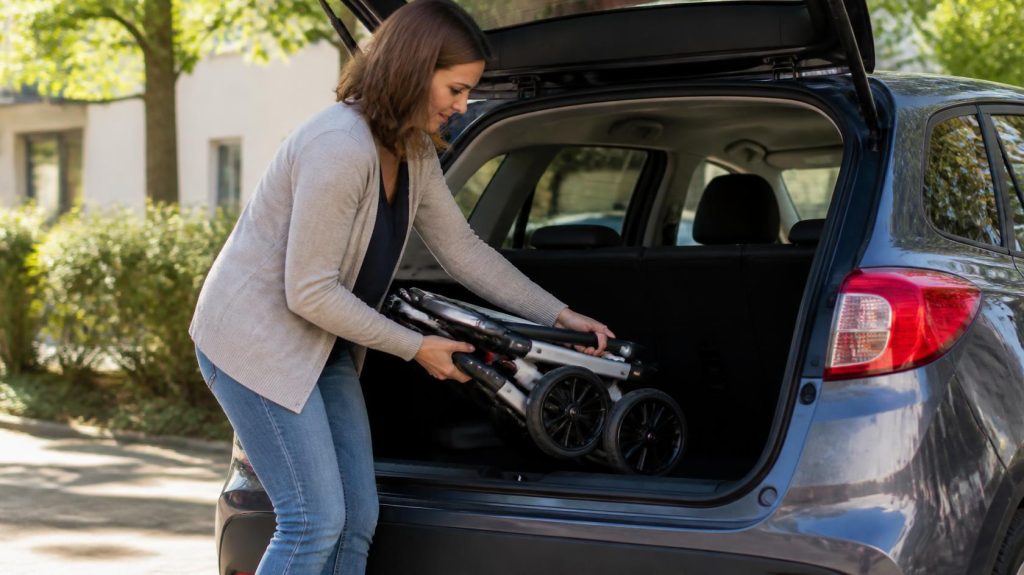
Visiting family, attending appointments, or taking road trips shouldn’t stop because of a mobility aid. Knowing how to fold and stow your rollator makes travel much smoother.
- Empty the storage pouch: Remove loose items so they don’t fall out during folding.
- Lift the seat: Pull upward on the seat strap or folding mechanism handle (most models feature a convenient pull-strap right on the seat).
- Collapse the frame: Push the sides together until the rollator clicks into its compact, locked folding position.
- Stow securely: Place the folded rollator flat in the trunk of the car or securely on the floorboards. Never place an unanchored rollator on a back car seat where it could become a projectile during a sudden stop.
10. Routine Maintenance Checklist
A safe rollator is a well-maintained rollator. Performing a quick inspection once a week takes less than three minutes and ensures your equipment won’t let you down.
- Check the brakes: Squeeze and lock the brakes weekly to verify they grab firmly.
- Inspect the wheels: Spin each wheel to check for hair, carpet fibers, or dirt wrapped around the axles that might cause sticking.
- Tighten fasteners: Periodically check the frame bolts and handle adjustment knobs to ensure nothing has worked loose from regular vibrations.
- Wipe down grips: Clean the handle grips and frame with a damp cloth and mild soap to remove oils and dirt.
Final Thoughts
Transitioning to a rollator doesn’t mean losing independence—in fact, it’s often the very tool that restores it. While four-wheeled walkers offer smooth gliding and the convenience of a built-in seat, staying safe comes down to building good habits: keeping your body close to the frame, locking your brakes every time you sit or stand, and performing quick routine checks on your equipment.
By taking a few extra moments to master these safety fundamentals, you or your loved one can navigate daily errands, outdoor walks, and visits with friends with confidence, stability, and peace of mind.
Frequently Asked Questions
What is the correct way to walk with a rollator?
To walk correctly with a rollator, stand upright inside the frame with your shoulders relaxed and your elbows slightly bent at a 15 to 20-degree angle. Position your hips in line with the rear wheels. Push the rollator a short step ahead of you, then step forward into the frame, keeping your body close to the device rather than trailing far behind. Look forward rather than down at your feet to maintain proper balance and posture.
How do I adjust the brakes on my rollator walker?
If your rollator brakes feel loose or fail to lock the wheels completely, locate the barrel adjuster nut situated along the brake cable near the handle or down by the wheel assembly. Turn the adjuster nut counter-clockwise to tighten the cable tension. Test the parking brakes by pushing the levers down until they click. Make small adjustments until both wheels lock securely and evenly without requiring excessive hand strength.
Can I lean my full weight on a rollator walker?
No, you should never lean your full body weight onto a rollator. Rollators are designed primarily for balance support, stability guidance, and resting when seated. Leaning heavily onto the handles or pushing down with all your weight—especially when rising from a chair—can cause the lightweight frame to tip forward or slide out from under you, resulting in a fall.
Is it safe to use a rollator on stairs or escalators?
No, it is extremely dangerous to use a rollator on stairs, steps, or escalators. The wheeled base creates an unstable foundation on sloped steps, making falls almost certain. Always look for elevators, ramps, or accessible entryways. If stairs cannot be avoided, fold the rollator completely, lock it, and carry it safely with assistance.
Why is my rollator pulling to one side when I walk?
A rollator that pulls to one side is usually caused by uneven handle height adjustments, a loose wheel bolt, or unequal brake cable tension. Check both handle height pins to ensure they are locked into the exact same numerical setting. Next, inspect the brake cables and wheel housing to ensure one brake pad isn’t lightly dragging against a wheel. Cleaning debris from the wheel axles often resolves minor steering pulls.
How do I know if my rollator handles are set at the right height?
Your rollator handles are set at the correct height when you stand upright inside the frame with your arms hanging naturally at your sides, and the top of the hand grips aligns precisely with the crease on the inside of your wrist. When you place your hands on the grips, your elbows should form a comfortable, slight bend. If your shoulders feel shrugged up or your back feels hunched, the height needs adjusting.
What is the difference between a standard walker and a rollator?
A standard walker has four non-wheeled rubber tips that require the user to lift and place the device forward with every step. A rollator features four wheels, hand brakes, and a built-in seat. Rollators allow for a continuous, smoother walking gait without lifting, but they require active hand brake control and better core stability because the wheels glide freely.
How do I safely sit down on a rollator seat?
To sit down safely, first wheel the rollator to a completely flat, level surface. Push both brake levers downward until they click into the locked parking position. Turn around slowly until the back of your legs lightly touch the front edge of the seat. Keep your hands on the handlebars for stability, bend at your knees and hips, and lower yourself smoothly onto the seat. Never attempt to sit without locking the brakes first