

If you care for an aging parent, you probably know this scene all too well. The morning sun comes through the window, but instead of starting their day, your loved one lies still in bed, waiting out the pain. “Just give me a few minutes,” they might tell you. “My knees and hands won’t move.”
Watching a parent slowly and painfully ease themselves to the edge of the bed—testing each joint before putting weight on their feet—is heartbreaking. It often takes 30 to 60 exhausting minutes just to shake off that overnight “rust.”
Morning joint stiffness in seniors is one of the most frustrating challenges faced by older adults with osteoarthritis (OA) or rheumatoid arthritis (RA). But while it is common, it isn’t something your family simply has to accept.
In this guide, we’ll look at why joints lock up overnight, gentle in-bed movements to get blood flowing before standing, and key updates to the bedroom environment that can dramatically reduce morning pain.
The Science Behind “Gelling”: Why Joints Lock Overnight
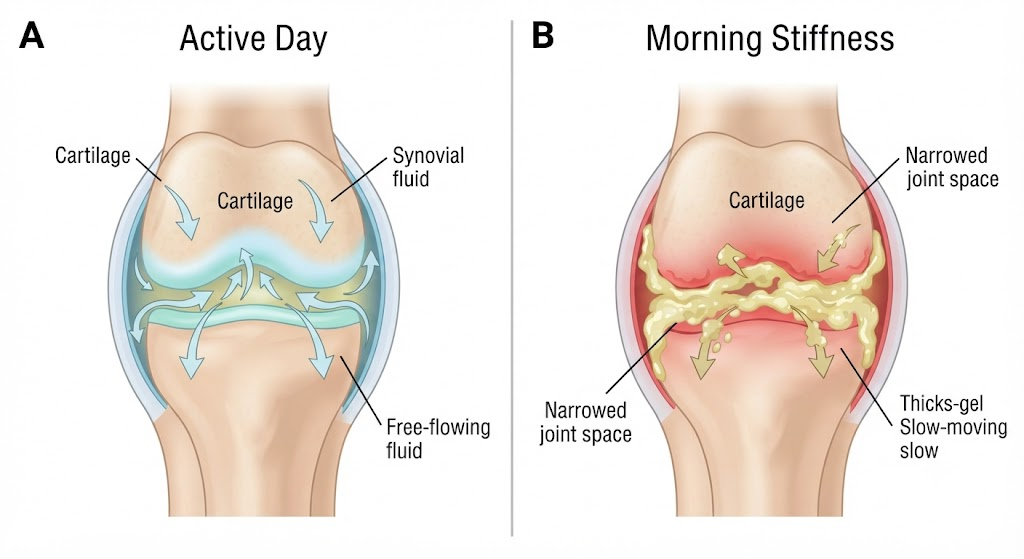
If you’ve ever tried to pour cold honey out of a jar, you already understand what happens to your parent’s joints overnight.
Medical professionals call this phenomenon “gelling.” During the day, constant movement keeps the joint’s natural lubricant—synovial fluid—warm and thin, allowing bones to glide smoothly past each other. But while your parent sleeps, three things create a “perfect storm” for stiffness:
- The Fluid Cooled Down: Movement generates heat and keeps fluid moving. Without it, plus the body’s natural overnight temperature dip, synovial fluid thickens into a heavy gel.
- Inflammation Pooled: For seniors with arthritis, overnight immobility means inflammatory fluid builds up inside the joint space with nowhere to go, causing deep swelling.
- The Surrounding Muscles Tightened: Holding the same position for 7–8 hours causes surrounding tendons and ligaments to contract and stiffen, especially on an unsupportive mattress.
When your parent wakes up, their joints feel locked until movement slowly warms that “gel” back into a smooth liquid.
Caregiver Insight: When patience wears thin during a slow morning, remember that this stiffness is a genuine biological challenge, not laziness. Approaching it with empathy helps reduce stress for both of you.
In-Bed Morning Warm-Up Routines: 5 Gentle Exercises
Helping a loved one get moving doesn’t start on the floor with intense stretching. It starts right where they are—safely nestled in bed, before gravity even enters the equation.
The goal of these exercises is not flexibility or strength building. The goal is gentle stimulation. We want to warm the tissues, lubricate the joints, and signal the muscles that it’s time to wake up, doing so in a low-impact way that minimizes pain.
Encourage your parent to perform these movements slowly and deliberately. Remind them to never push into sharp pain—discomfort is okay, but stabbing pain is a signal to stop.
Exercise 1: The Ankle Pump (Waking Up the Ankles)

This simple movement is excellent for encouraging blood flow from the legs back toward the heart and lubricating the ankle joints.
How to Perform It:
- Have your loved one lie on their back with legs extended.
- Ask them to gently flex their feet, pulling their toes toward their shins as far as comfortably possible. Hold for 3 seconds.
- Then, have them point their toes away from their shins, like a ballerina. Hold for 3 seconds.
- Repeat this “pump” motion 10–15 times.
- Follow this by slowly rotating each ankle in circles, first clockwise, then counter-clockwise, 5 times each way.
Exercise 2: The Knee Hug (Releasing Hips and Lower Back)

For many seniors, especially those with hip arthritis or sciatica, the lower back and hips feel locked tight. This movement helps gently decompress the spine and mobilize the hip joint.
How to Perform It:
- While lying on their back, ask them to bend their knees, keeping feet flat on the mattress.
- Gently, one leg at a time, have them bring a knee toward their chest.
- If possible, they can clasp their hands around their shin or behind their thigh (avoiding pulling directly on the knee cap) to gently pull it closer. Hold for 10–15 seconds.
- If reaching is difficult, a simple Leg Slide variation works well: have them keep their heel on the bed and slowly slide it toward their buttocks, then extend it back out.
- Repeat 3–5 times on each leg.
Exercise 3: The Clamshell (Gentle Hip Rotation)

This is a very low-impact version of the standard physical therapy exercise, designed to gently rotate the hip joint without bearing weight.
How to Perform It:
- Have them stay on their back, knees bent, and feet flat on the mattress, positioned slightly wider than hip-width apart.
- Instruct them to gently drop one knee inward toward the center of the bed, pause, and then return it to the starting position.
- Then, gently drop the other knee inward, pause, and return.
- They can alternate knees, repeating 10 times on each side.
Exercise 4: Shoulder Shrugs (Easing Neck Tension)

Stiffness isn’t always limited to the legs and hips. Arthritis in the neck (cervical spondylosis) often causes tightness that radiates down into the shoulders.
How to Perform It:
- Have them sit up carefully on the edge of the bed, or stay lying on their back if sitting up is too difficult initially.
- Ask them to inhale deeply and lift their shoulders straight up toward their ears (as if shrugging).
- Exhale sharply while relaxing their shoulders, letting them drop completely.
- Repeat this shrug-and-drop motion 10 times.
Exercise 5: Finger Squeezes and Spreads (Mobilizing Stiff Hands)

Hand stiffness from Rheumatoid Arthritis or Osteoarthritis can make gripping blankets or pushing themselves up nearly impossible. This exercise targets the small joints.
How to Perform It:
- Have them rest their hands comfortably, palms up, on their lap or on a pillow beside them.
- Ask them to slowly make a gentle fist (they don’t need to squeeze tightly). Hold for 3 seconds.
- Then, have them slowly open the hand, spreading their fingers as wide as they comfortably can. Hold for 3 seconds.
- Repeat this sequence 10–15 times.
Caregiver Tip: Creating a morning routine takes practice. You might need to gently remind your parent these exercises exist, or even perform them with them—modeling the motion can be incredibly helpful. Keep a glass of water and their daily medication on the bedside table so they are ready to take their pain relief, if prescribed, before these exercises, maximizing their effectiveness.
Bedtime Rituals for Softer Joints: Preparing for Tomorrow Tonight
It may seem counterintuitive, but managing morning stiffness often begins the night before. By preparing the joints for sleep, we can minimize the degree of “gelling” that occurs overnight.
These rituals help relax muscles, soothe inflammation, and keep joints warm, reducing the likelihood they will lock up so severely.
1. Heat Therapy (The Warm Soak)

Applying moist heat is one of the most effective ways to relax muscles and increase blood flow to stiff joints.
Why it works: Heat penetrates deep into the tissue, changing the viscosity of the joint fluid (making it thinner) and increasing the elasticity of tendons and ligaments, which reduces resistance to movement.
How to implement:
- The Evening Bath: A warm (not scalding) bath or shower 30–60 minutes before bed is ideal. Encourage your parent to soak for at least 15–20 minutes. If getting into a tub is unsafe or difficult (a major fall risk), consider investing in a safe walk-in tub or ensuring they have a sturdy shower chair and grab bars.
- Targeted Heat: If a full bath isn’t feasible, target specific problem areas. Have them use a moist heating pad (never a dry electric blanket, which can pose a burn risk if they fall asleep) on their hips, knees, or shoulders while they relax and read in an armchair before heading to bed. A warm, damp towel wrapped around the joint also works wonders.
Safety First: Never allow a senior to sleep on a heating pad. This can lead to severe burns, especially if they have thin skin or reduced sensation due to neuropathy. Always use a timer.
2. Warm, Comfortable Sleepwear
Keeping the entire body warm overnight is surprisingly critical for preventing morning joint rigidity. As mentioned earlier, a drop in body temperature contributes to the thickening of synovial fluid.
- How to implement: Ensure your loved one is sleeping in comfortable, warm pajamas made of breathable fabrics like flannel or fleece. Don’t forget the extremities—socks can make a significant difference. Keep the bedroom temperature comfortably warm, rather than cool, overnight to help maintain joint warmth and mobility.
Environmental Factors: Temperature, Support, and Strategic Sleep Solutions
The quality and temperature of your loved one’s sleep environment play a massive, often overlooked role in how they feel upon waking. If their body is fighting the mattress or the cold all night, their joints will pay the price in the morning.
1. Maintaining Overnight Warmth
While this was touched on in the bedtime routine, it’s critical to consider the bedroom environment itself. A cold room will almost certainly exacerbate morning stiffness.
- Strategy: Set the thermostat to a comfortable, stable temperature overnight (typically between 65–70°F or 18–21°C). Ensure they have adequate, lightweight bedding that provides warmth without feeling heavy or restrictive, which can make turning over difficult. Electric blankets or heated mattress pads can be wonderful tools, provided your parent can manage them safely and doesn’t have issues with skin sensation. Always recommend pre-heating the bed and turning the device off before actually getting in to eliminate any burn risk.
2. Mattress and Support
The surface your loved one sleeps on is arguably the most important environmental factor influencing morning pain.
- Why it matters: Sleeping on an overly firm mattress can create concentrated pressure points on stiff hips and shoulders, cutting off circulation and causing joints to scream in protest. Conversely, a sagging mattress offers no support, forcing joints out of alignment and causing muscles to spasm all night in an attempt to compensate.
Surface firmness traps joint fluid and pressure. Upgrade your sleeping surface with our guide on the best mattress for arthritis and osteoporosis.
- Strategy for Seniors with Stiffness: Generally, a medium-firm mattress strikes the best balance for seniors with arthritis. It provides support to maintain spinal alignment while offering enough give (especially a mattress with a memory foam or latex comfort layer) to cushion sensitive joints and relieve pressure points. Adjustable beds are also a phenomenal investment, allowing seniors to elevate their head and legs slightly, which improves circulation and reduces pressure on the spine and hips.
3. Bed Height and Ease of Getting Up
The battle isn’t just about feeling stiff; it’s about safely overcoming that stiffness. If the bed is too low, getting up requires a tremendous amount of force that arthritic knees and hips simply cannot generate.
- Strategy: The ideal bed height is one where your loved one can sit on the edge of the bed with their feet flat on the floor and their knees bent at a 90-degree angle.
- If the bed is too low: Use sturdy bed risers to elevate the frame.
- If the bed is too high: This is a fall risk. Consider a lower-profile mattress or, as a last resort, a lower bed frame.
- Add Assistance: Install bedside safety rails (transfer handles) that anchor securely between the mattress and box spring. These provide a sturdy leverage point for your loved one to push off from, reducing the strain on their joints as they transition from lying to sitting to standing.
Final Thoughts

Managing severe morning joint stiffness in seniors is not about finding a magic pill or a single miracle cure. It is about building a comprehensive support system that addresses the problem from every angle: understanding the biology, performing gentle in-bed warm-ups, implementing soothing bedtime rituals, optimizing the sleep environment, and providing patient, compassionate physical and emotional support as a caregiver.
By proactively managing this stiffness, you are doing far more than just reducing pain. You are empowering your loved one to begin their day not with dread, but with confidence, dignity, and the ability to maintain their independence. You are helping them preserve their joints, protect their mobility, and reclaim those critical morning hours for connection and joy.
As you implement these strategies, remember to track what works for your parent—every senior is unique, and their arthritis management plan should be personalized. Stay connected with their healthcare team